
Ceramic Braces

December 25th, 2019

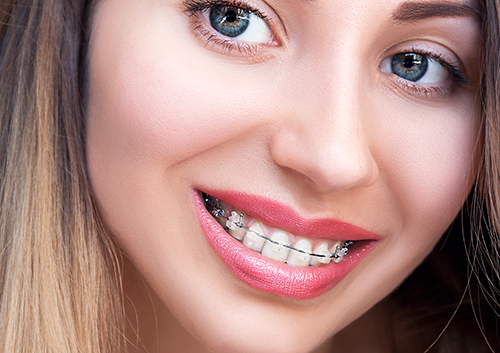
Congratulations! You have made the decision to get orthodontic treatment at our Hanover, NH office. Now it’s time to choose among your various appliance options. Traditional metal brackets and wires, lingual braces, a series of aligners—they all have positives to recommend them. And for some people, ceramic braces are the clear favorite.

Ceramic braces work like regular metal braces. Brackets are bonded to the front of each tooth, and rubber bands surrounding the brackets hold the arch wire that gradually moves the teeth into alignment.

Ceramic braces, however, use brackets made of clear or tooth-colored ceramic or porcelain which blend beautifully with the color of your tooth. The elastic ligatures, or rubber bands, can be chosen to match the brackets or your enamel. There are self-ligating ceramic brackets which don’t use bands at all. Technology is even working on ways to make the arch wire less visible! The end result is braces that are almost undetectable.

If you want a less obvious appliance for professional or personal reasons, talk to us about ceramic braces. As always, there are other factors to consider before you decide, which we will be happy to discuss with you.

  • Ceramic brackets are very strong, but they are still more brittle than the metal model. If you play a contact sport, these might not be for you. (But whatever braces you choose, please wear a mouthguard when playing sports.)
  • Ceramic braces might not be ideal depending on the amount of alignment and bite correction that is needed. They might also take a bit more time to bring your teeth into alignment. We will be able to tell you if ceramic braces will work for you and if they might require a longer period to move your teeth to their perfect position.
  • Brackets can sometimes be somewhat larger (though this isn’t always the case), and, because they can be abrasive, are often recommended for upper teeth only. This way, the lower teeth will not impact, or be impacted by, contact with the upper teeth.
  • Oral hygiene can trickier with ceramic braces. Although today’s brackets aren’t as prone to staining, you still need to be careful to brush away the plaque that can accumulate around the brackets. And the bands are susceptible to staining by the usual suspects—coffee, tea, colas, blueberries, or any strongly colored food or beverage.
  • Costs will differ depending on the treatment method you choose. Talk to us about cost comparisons with other orthodontic treatments.

Ceramic braces, because they are so much less visible, are a popular orthodontic option, especially for older teenagers and adults. If you are interested, talk to Dr. Donald Neely about this effective way to straighten your teeth—discreetly. Ceramic might be the clear solution for creating your lasting, beautiful smile.


Orthodontic Myths

December 18th, 2019

Some myths never wear out their welcome. If the Tooth Fairy helps your child transition from baby teeth to adult teeth, more power to her! On the other hand, some myths we can do without. Here are five common misconceptions about orthodontics, and the reality behind the myth.

  • It’s Only Cosmetic

If you think orthodontists can make a crooked smile straight, you’re right! Creating a beautifully aligned smile is one of our specialties. And if your primary interest is in a straight, even smile for you or your child, that’s a good thing. You can’t underestimate the confidence a beautiful smile brings. But please don’t think that’s all we do. In orthodontics, aesthetics and function work together. An essential part of an orthodontist’s work is diagnosing and treating malocclusions, or bad bites. The correct alignment of teeth and jaw is what makes a beautiful smile a healthy one as well.

  • I Don’t Need an Orthodontist for Orthodontic Treatment

All dentists receive comprehensive training and experience in order to earn their dental degrees. But did you know orthodontists like Dr. Donald Neely receive two to three years of additional formal training, concentrating specifically in the field of orthodontics? An orthodontist is a specialist, and diagnoses and treats problems with tooth alignment while taking into account dental, jaw and facial development. That is why an orthodontic specialist is best qualified to create a unique, custom-tailored treatment plan for each patient in order to achieve a beautiful, balanced, and healthy smile.

  • My Child is Too Young for Orthodontic Treatment

We actually recommend that every child see an orthodontist for an evaluation by the age of seven. It’s important to be aware of any potential orthodontic problems that might affect your child’s later years, but we can also treat problems even before braces are on the horizon. If your child’s mouth is very small, we may recommend gently enlarging the upper dental arch with the use of a palatal expander to accommodate adult teeth as they erupt. If a baby tooth is lost too soon, we can provide a space maintainer so your child’s permanent tooth can erupt in the right place. We can even treat bite problems before all the adult teeth arrive. A visit when your child is young might help prevent the need for more complicated treatment in the future.

  • I’m Too Old for Orthodontic Treatment

You’re really not. As long as your teeth and gums are healthy, orthodontic treatment is a great way to keep them healthy. Crowded teeth and malocclusions can lead to problems like worn or cracked enamel, headaches, jaw problems, increased tooth decay, and periodontal disease, to name but a few. And today’s orthodontics offer a much wider variety of treatment options than the metal gear you remember from your high school days. Which leads us to our last myth of the day:

  • Those Metal Braces Aren’t for Me

In that case, it’s a good thing we have many other options to offer. Ceramic brackets and clear elastic ligatures make traditional braces much less visible. Lingual braces use brackets and wires placed behind the teeth, which are almost impossible to detect. And clear aligners allow you to subtly reposition your teeth with each new aligner tray—and are removable if need be. In fact, even those metal braces you might remember from your own high school days have gotten smaller and sleeker. Talk to us about the many discreet options available for older and younger patients.

If you are interested in what orthodontics might do for you, give our Hanover, NH office a call! We are here to help you discover what’s possible and then to design the best possible treatment plan in order to achieve it.  Let’s make your beautiful, healthy smile a reality!

Famous Teeth throughout History

December 11th, 2019

We probably all remember sitting through history lessons during our schooling years. Revolutionary war heroes, English royals, and pop-culture icons filled the pages of our textbooks. Although you may recall a detail or two about their historical significance, how much do you know about their teeth?

Picture England in the mid 1500s. People wore frilly clothes as they hustled along the street, and talked about the latest import from the Indies: sugar. Wealthy Brits did not hesitate to indulge their sweet tooth, and it was no different for the monarch, Queen Elizabeth I.

The queen was especially fond of sweets, but not so fond of the dentist. Her teeth rotted; they turned black and gave off a foul odor. Eventually, Elizabeth lost so many teeth that people found it difficult to understand her when she spoke.

Flash forward to the Revolutionary-era colonies in the 1770s and we encounter the famous dentures of George Washington. They were not made of wood, but rather a combination of ivory and human teeth, some of which were his own pulled teeth and some he purchased from slaves.

Washington did not practice proper dental hygiene throughout his life. He began to suffer dental problems as early as age 24, when he had his first tooth pulled. By the time he was inaugurated in as the first president in 1789, he had only one tooth remaining in his mouth, which was pulled in 1796.

Washington’s dentures were made too wide and never quite fit his mouth properly. He complained that they were painful to wear and caused his jaw to protrude visibly outward.

If you’ve heard of Doc Holliday, you know him as the gun-toting, mustached criminal that ran the Wild West in the late 1800s. You might be surprised to learn that John Henry “Doc” Holliday actually had a career as a dentist.

He graduated from dental school in 1872 and began to practice in Griffin, Georgia. Holliday was later diagnosed with tuberculosis and his violent coughing fits during exams drove patients away. Jobless, he packed his bags for Texas and spent the rest of his days running from town to town as a criminal.

The Beatles brought pop music and British culture to their fans, as well as … teeth? In the mid-1960s, John Lennon had a molar removed that he presented as a gift to his housekeeper, Dorothy. Dorothy’s daughter was a huge fan of the Beatles and he thought she might like to a keepsake. Her family held onto the tooth until 2011, when they auctioned it off to a Canadian dentist for $31,000.

These historical figures had very different experiences with their teeth, but it’s safe to say a bit of extra brushing and flossing could’ve saved them a lot of trouble. Whether you’re queen, president, or an average citizen, it’s up to you to practice good dental hygiene!

Ask a member of our team at our Hanover, NH office if you have any questions about how to keep your teeth in top shape!

What do you love about our practice?

December 4th, 2019

At Hanover Orthodontics, we have been creating beautiful smiles for years. Whether you or your family have visited Dr. Donald Neely and our team for a single visit or have been loyal patients throughout the years, we would love to hear your thoughts about your experience! In fact, we encourage you to leave a few words for us below or on our Facebook page!

We look forward to reading your feedback!

outside of office directions