
What Your Braces Rubber Band Color Says About You

February 4th, 2016
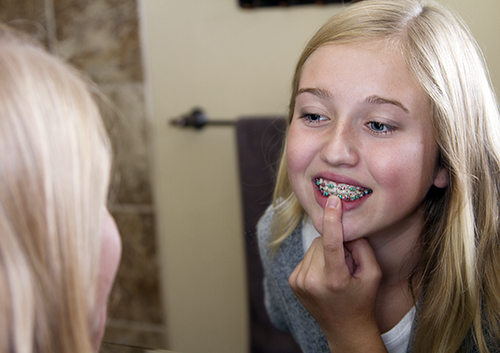
However you may feel about having to wear braces, choosing the color of your rubber bands is sure to bring a smile to your face. Whether you want to express your creativity, coordinate your braces with your outfits, or show some serious school spirit, decorating your mouth with colorful bands takes some of the stress and self-consciousness out of wearing braces. So what do your rubber band colors say about you? Look no further than our rubber band horoscope.

Red. You’re intense and forward thinking, and that you won’t back down no matter how big the challenge. Red is also the color of the heart, so red rubber bands indicate that you’re a caring, loving person.

Blue. Blue means you’re chill – as cool as a cucumber. You’re one cool customer, as the saying goes. You’re relaxed and calm, even when your mom says you can’t chew any gum or eat popcorn because of your braces.

Green. Look at a traffic light and green means go, right? So you’re the type of person who’s always on the move. Go, go, go! It also means you’re generous and kind. Green is the color of nature and spring, so it says you love Mother Earth. Perhaps you even recycle. Green is the color of good luck.

Orange. You’re daring and wild, flamboyant and fun. Orange may indicate you’re an artist or a drama student. It says you have a big personality and that you don’t care what other people think about you. However, orange is also the color of balance and energy. And being flamboyant and fun takes a lot of energy!

Purple. You’re the creative type, for sure. You beat to a different drummer and think outside the box. It says you're mysterious. Purple is the color of royalty, and when you wear your purple rubber bands you are royally cool.

Color Combinations

What if you can’t choose just one color? Well, you can decorate your teeth with alternating colors. You can choose the colors of your favorite sports team or holiday colors like red and green. If you’re still stumped as to what colors to choose, ask Dr. Donald Neely or a member of our team. We can let you in on all the trends our other patents are sporting at our Hanover, NH office!

Invisalign® vs. Traditional Braces

January 28th, 2016

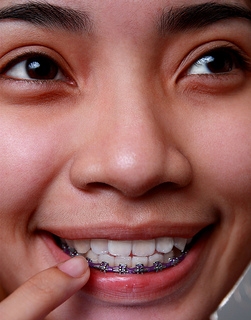
A great smile can go a long way. Scientific research suggests that people who smile are perceived as more attractive and confident than those who don’t flash their pearly whites. When it comes time to invest in orthodontics to improve your beautiful smile, choosing the best option can be daunting. Comparing Invisalign to traditional braces is a great way to determine what orthodontics make most sense for your unique smile.

How is Invisalign different?

Unlike traditional braces, in which brackets are affixed onto each tooth and connected by wires Invisalign corrects orthodontic problems using a set of clear trays. These trays are specially formed to fit your teeth, allowing you to wear them 24/7.

Aesthetics

One of the primary advantages of Invisalign is that the clear trays are nearly invisible. Particularly for adults self-conscious about appearing professional with traditional braces, Invisalign can correct orthodontic issues without capturing the notice of others. Their nearly invisible appearance is one of the topmost reasons that orthodontic patients choose Invisalign.

Complexity of the Orthodontic Problem

Invisalign works well for people who have relatively minor problems, such as crooked teeth or small gaps between teeth. For more complex problems, particularly issues with bite or vertical problems (i.e., one tooth being significantly higher than another), traditional braces may be better at pulling teeth into alignment.

Eating and Drinking

Invisalign trays are removable, meaning that you cannot eat or drink while wearing them. Unlike traditional braces, however, you are not limited in the foods you may eat. Chewy, sticky, or hard foods may be eaten, provided that you brush your teeth before reinserting the Invisalign trays.

In the end, only you can weigh the pros and cons of Invisalign versus traditional braces. Consult with Dr. Donald Neely to understand how these orthodontic interventions may work for your unique situation.

The Evolution of Braces

January 21st, 2016

Did you know that even in ancient times, people wanted to improve the look and function of their smiles? Hanover Orthodontics thinks of modern orthodontic appliances as sleek, efficient technology, but this was not always so! Take a look at the highlights in the evolution of braces.

Ancient Times: From Greece to Rome

  • According to The Angle Orthodontist, Aristotle and Hippocrates first thought about methods for straightening teeth between 400 and 300 BC.
  • The Etruscans, in what we now know as Italy, buried their dead with appliances that maintained spaces and prevented collapse of their teeth and jaws during life. Archaeologists have discovered mummified remains in various locations that have metal bands wrapped around the teeth.
  • A Roman tomb has also been discovered in which the teeth were bound with gold wire, including documentation on the wire’s use as a dental device.

18th Century: A French Development

  • The French dentist Pierre Fauchard is acknowledged as the father of modern dentistry. In 1728 he published a book that described various methods for straightening teeth. Fauchard also used a device known as a “blandeau” to widen the upper palate.
  • Louis Bourdet was another French dentist who published a book in 1754 that discussed tooth alignment. Bourdet further refined the blandeau and was the first dentist to extract bicuspids, or the premolar teeth between canines and molars, for the purpose of reducing tooth crowding.

19th Century: Orthodontics Defined

  • Orthodontics started to become a separate dental specialty during the early 19th century. The first wire crib was used in 1819, marking the beginning of modern orthodontics.
  • During this period, gold, platinum, silver, steel, gum rubber, vulcanite, and occasionally wood, ivory, zinc, and copper were used — as was brass in the form of loops, hooks, spurs, and ligatures.
  • Edward Maynard first used gum elastics in 1843 and E. J. Tucker began making rubber bands for braces in 1850.
  • Norman W. Kingsley published the first paper on modern orthodontics in 1858 and J. N. Farrar was the first dentist to recommend the use of force over timed intervals to straighten teeth.

20th Century: New Materials Abound

  • Edward Angle developed the first classification systems for malocclusions (misaligned teeth) during the early 20th century in the United States, and it is still in use today. Angle founded the American Society of Orthodontia in 1901, which was renamed the American Association of Orthodontists in the 1930s.
  • By the 1960s, gold was universally abandoned in favor of stainless steel.
  • Lingual braces were the “invisible” braces of choice until the early 1980s, when tooth-colored aesthetic brackets made from single-crystal sapphire and ceramics became popular

Today

As we arrive in the present, you need only look at your own braces to see how far we’ve come. Your treatment plan was probably created with a 3D digital model, and we’ve likely used a computerized process to customize your archwires. Perhaps you have clear aligners, self-ligating brackets, or highly resilient ceramic brackets with heat-activated wires.

Orthodontics has come a long way from the days of Aristotle, and even the bulky wrap-around braces of just 60 years ago. Regardless of your specific treatment plan, the development of high-tech materials and methods has made it possible for your orthodontic experience to be as effective, efficient, and comfortable as possible. Call our office in Hanover, NH to schedule your first orthodontic consultation!

Eating with Braces: Braces-friendly snack recipe

January 14th, 2016

At Hanover Orthodontics, Dr. Donald Neely and our staff know that eating with braces can be tricky. You want to avoid damaging the bands, brackets, and wires, since any damage can delay the progress of your treatment. After adjustments, your mouth may also feel sore, which will make eating more of a chore than a pleasure.

The good news is you do not have to avoid all of your favorite foods; there are ways you can still enjoy them. Try some of these ideas and recipes for great snacks that are friendly to your braces.

Fruits and Vegetables

You still need to eat fruits and vegetable for the healthy nutrients. The trick is to cut harder items into small pieces that you can chew easily with your back teeth. Canned fruits are also a great choice, but select fruits packed in water to avoid the heavy, sugary syrups. It’s a good idea to avoid excess sugar with braces, since sugar build-up around your braces can lead to plaque formation.

Single-serving packages are available to make your snack portable and convenient. Enjoy vegetables with a small amount of a healthy dip. Hummus or yogurt can be used for flavor without adding unnecessary fat or calories.

Banana and Honey Smoothie

Smoothies are a healthy treat, and you can create these drinks with your favorite ingredients. You can use a variety of yogurt types for your smoothie: regular, low or non-fat, and Greek are all great choices.  Here’s one of our favorite smoothie recipes:

  • 6 ounces of your choice of yogurt
  • 1 or 2 teaspoons of honey
  • 1 ripe banana
  • 6 ounces milk

Chop the banana into smaller pieces and put all your ingredients into a blender. Blend on low until everything is mixed and then blend on high for about 20 seconds to make your smoothie fluffy.

The great thing about this recipe is that you can substitute just about any small or cut-up fruit for the banana. Try blackberries, raspberries, or peaches for variety. Try to avoid fruits with small seeds; strawberries can leave bits stuck in your braces. You can even make a smoothie with peanut butter and jelly!

Please ask our team if you have any concerns regarding the foods you can safely eat while wearing braces.

outside of office directions